50 YEARS OF SOCCER STORIES
2026 marks the celebration of our 50th Anniversary as Sherwood Park District Soccer Association.
These are our stories…
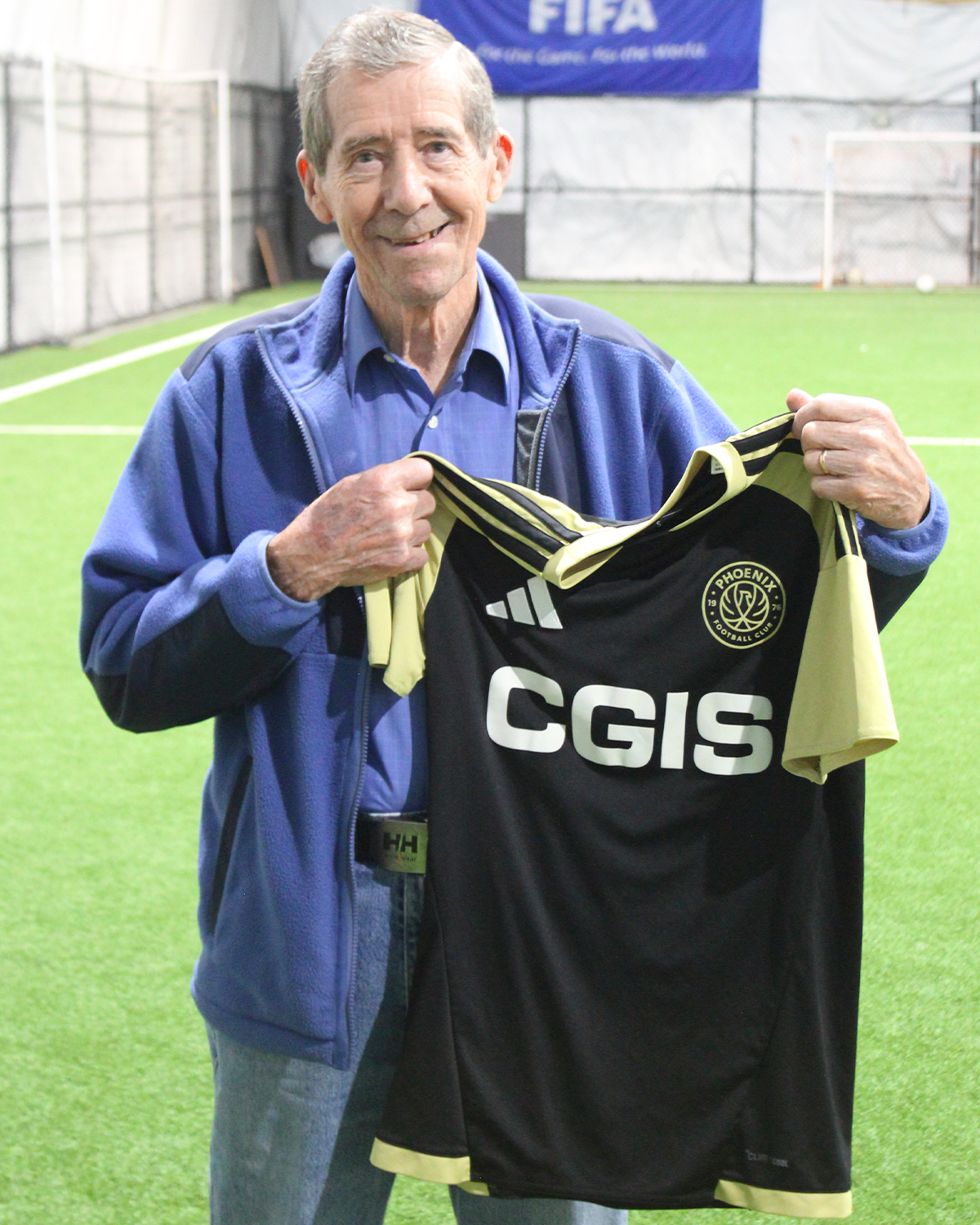
“Enjoy the Game” with Jim Lyon
By Chris Yakiwchuk (September 2026)
Margaret Wheatley said, “There is no power greater for change than a community discovering what it cares about.” Now at almost ninety-two years of age, Jim Lyon can reflect on the coming together of a like-minded group of people in the fledgling Sherwood Park community, and the impact their small gathering has had fifty years later.
Hailing from Aberdeen in Scotland, which was primarily a fishing village in his youth, Jim’s experience with the game came from playing amongst friends, “in school and in high school”. He spent his childhood and adolescence in Aberdeen, describing it as “[a city] of granite-faced buildings, so when the sun shines it just glistens”. Jim left school at fourteen years of age, pursuing an apprenticeship as a mechanic. As an adult, Jim and his new family then moved to Edmonton in 1969; “they were advertising for tradesmen, in Canada and in Australia. I decided to try Canada,” he chuckles, “I’ve never been there, but we’ll try it!” The family then settled in Sherwood Park in 1972 and have never looked back.
The same year, Jim got involved with Sherwood Park Soccer. “It all started in 1972 with Dick Devore. He organized it - and it was in the local paper of course - ‘meeting with the soccer association’. I attended the meeting; it was in [the Sherwood Park Arena], just a room in there to do [the meeting]. There was four of us, and that’s what we talked about – getting a soccer association going.”
“We had no money, and we discussed that, and we said, ‘OK we’ll have a raffle.’ We had a television; we got a television from somewhere – a new one, and we raffled it in Sherwood Park, [and we] sat in [Sherwood Park Mall] and sold tickets and made some money to run the club. That was it!”
From the result of that small meeting and the subsequent raffle, the first registrations started to come in. “It started just by word-of-mouth,” Jim recalls, “I don’t think there was [an ad in] the local paper, it just got out [to] people [who were] interested in it, and we had just under a hundred kids in our first year. A big start,” he smiles.
“Nobody knew how the field had to be laid out, so Doug (Recreation Staff at Strathcona County) loaned me the paint and the machine, and I marked the fields with him.” Salisbury Composite High School was the site of the first lined soccer field in Sherwood Park. “The fir trees [that were planted] around the field, that’s where I taught the kids to dribble around and dribble back,” Jim adds.
But to get the soccer season started, and the players doing more than just dribbling around trees, Jim and the other founding members knew they needed some extra help. “You had to do with what you had. Everyone, as I call it, ‘mucked-in’ to get the job done. That’s what we had to do! We needed coaches, and luckily, we got coaches – good coaches! Mostly from Glasgow or Edinburgh, [ones] who knew the game better than I did back then!” Little did the group know, but they had laid the foundation for volunteering - an aspect of our club that we still rely on today. We greatly appreciate the involvement of our community members and volunteers in various roles and responsibilities so that kids can continue to play and have fun.
“We met at different houses, that’s where we held our meetings – because we didn’t have a [dedicated] facility.” When asked what the meetings covered, it seems the logistics of football doesn’t change much at all in fifty years. “Sponsorship - trying to get that, who’s going to look after the uniforms, referees and the troubles we were having with them, and coaches – on the sidelines and getting on the field. Our younger kids, they wanted to referee, but they got out there and they didn’t know the rules; it was more or less ‘this is a fun thing’ that [the club] started off as.”
The uniforms themselves, it turns out, would be forever tied into Edmonton Sports history through a surprising source.
“Ken Hitchcock (Head Coach with the Stanley Cup-winning Dallas Stars in 1998-99, and Edmonton Oilers Head Coach in 2018-19), was the equipment manager at United Cycle, and that’s where we bought the shirts from.” The procurement aspect was handled, but without a designated headquarters yet, who ended up looking after everything?
“In the [Sherwood Park Arena], there was a room up the stairs that was our equipment room. My wife, Helen, looked after all the uniforms; she bought the uniforms and got crests put on them. She took [the jerseys] in after the games and washed them, and then we had to come and pick them up from the [arena] again – so it was a lot of work, [especially] when we got to fifteen or twenty teams, it was a lot.”
“It wasn’t necessarily black [jerseys] and white [jerseys],” Jim says referring to our interview with Derek Douglas. “We had different colours – green and white, we had a lot of that, but also red, purple – all different kit. It was fun. That was more or less our objective – make it fun for the kids and just get soccer going. Enjoy the game.”

Nov. 1975 Sherwood Park News Article, Phoenix FC Archives
But not only having kids enjoying the game but having them playing the game “properly” was the most monumental task in Jim’s opinion.
“The rules of the game [were the biggest challenge].” Jim explains, “it’s why I quit being the President (1973-1975) and started refereeing. I had some basic rules, [which were] not exactly right, but then when Derek [Douglas] came on, he had [referee experience] so he knew the rules, I guess. Then Derek started putting on referee classes. So, I took that, and I stayed in refereeing from then on for over twenty-five years.”
When asked about the growth of the club, Jim sheds some light on the soccer landscape at the time. “We played against the City of Edmonton teams – they had more teams so we would go out there [to Edmonton] and they would come out here [to Sherwood Park]. There wasn’t [at the time] too much development going on yet, because people still didn’t really know the game. Even my son – he played baseball after soccer,” Jim laughs before continuing, “I think St. Albert had a team. By that time, we were up to probably about eight or nine hundred kids of different ages by ’76 to ‘78, and it just grew from there. And I mean it really blew up – over a thousand kids in just a matter of four or five years.” When asked about the relationship with the Edmonton leagues and if there was any desire to join in with them; “No, no,” he says with a cheeky smile and a wink, “Sherwood Park was Sherwood Park”.
I point to the logo on my sweater, emphasizing the year 1976 as when we officially gained our ‘District’ status, despite the first year on record being 1972. I ask Jim to walk us through the process of developing a small community organization into the official non-for-profit Sherwood Park District Soccer Association (SPDSA). “I don’t really know!” Jim admits with a grin, “because quite honestly, we started calling it that [SPDSA], and it just developed into that. It just grew – and it grew fast! We just played the game; it was a fun game, and people were interested in it!”
Yet with all things, you know when it’s time to move on, and so did Jim. “Two years, maybe three at the very most that I was [directly] involved [with the club]. There were a lot of other Scottish people involved with it as well, and they were pretty strong-willed some of them, so I said, ‘OK, go take it and run with it!’”
After his terms as SPDSA President ended, Jim continued in the game, refereeing all around the province. While he didn’t return to the club he helped found, by nature of being a local in the area, Jim kept tabs on the organization’s status.
“When Phoenix took over [from Sherwood Park Rangers], it was more development [focused], and the kids were getting taught by people that knew the game and knew how to play the game. [The club has] become more professional, and I’m very proud of that, [and what the club] has developed into. It’s taken a long time but, you know, that’s evolution.”
As to what he hopes the next fifty years has in store for our community club, Jim gives his words of wisdom; “I’d like to see more facilities, and development for them. [But the game] is still growing, so just keep going the way you’re doing it.”
From humble beginnings in the back of a hockey arena, to the new dedicated indoor field currently being built across the street from our Phoenix FC office, Jim has seen the club grow and evolve. The power of community spirit and a willingness to come together and make something happen, proudly remains a part of our club’s DNA; and as Jim so eloquently puts it, at the end of the day, we all have to “enjoy the game.”