
50 YEARS OF SOCCER STORIES
2026 marks the celebration of our 50th Anniversary as Sherwood Park District Soccer Association.
These are our stories…
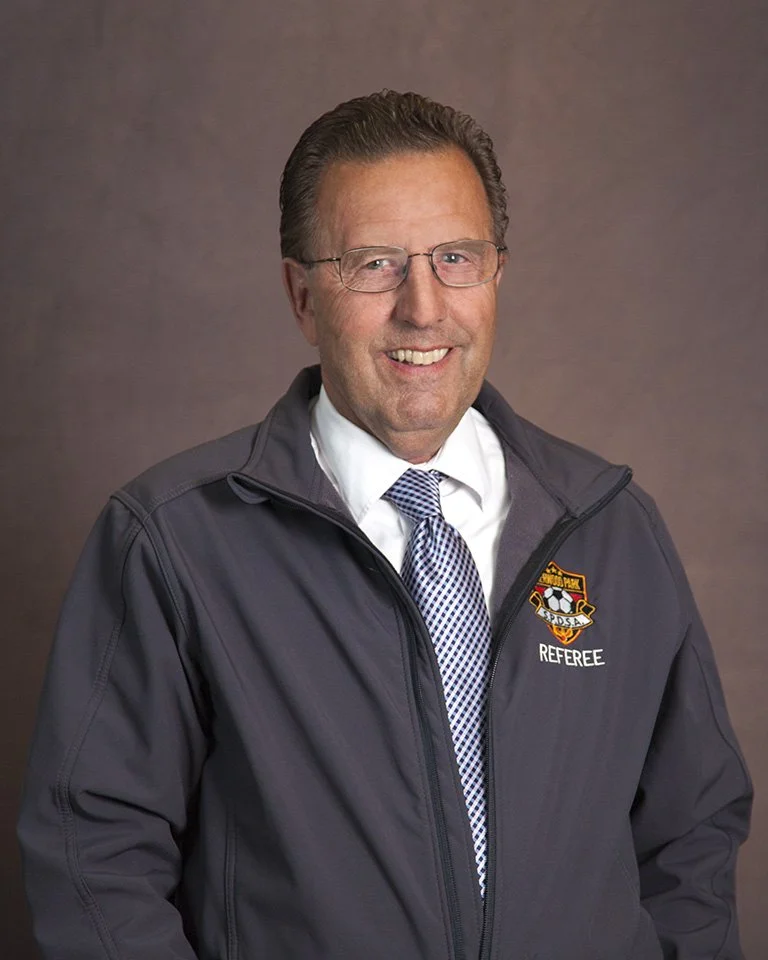
“Making The Call” with Derek Douglas
By Chris Yakiwchuk (August 2026)
Starting his first term in 1973, Derek’s leadership oversaw the numbers swell to over a thousand players by the end of his second Presidential term. “My wife took a coaching course; she took a referee course – as other members of the board [and their] spouses did – just to get into it. It was amazing how fast it grew,” he says, acknowledging that the membership was buoyed by a large influx of population moving into Sherwood Park in that time. “It was a good learning experience,” he adds. When asked about the greatest challenge he remembered facing from the rapid growth of the club’s membership, he smiles and simply states, “Uniforms”.
“As the time went on, there were more [players] coming in. Of course, some of them were just playing in white t-shirts versus black t-shirts because we didn’t have much [in way of uniforms].” On the topic of budget, he went on saying, “there wasn’t much money – and this is what I keep telling people; money must come in for it to go out.” But the population and membership boom was a turning point for the club. “Sherwood Park was one of the hubs for [putting] your kids in sport. Once [we] got that, with the uniforms coming online, with the teams that we were able to establish to play against each other – we didn’t [need to] go into Edmonton [except for tournaments].”
With a solid membership base now established, and enough uniforms for everyone, Derek could turn his attention to what would ultimately become his life’s work; “The other issues we had at that time – we didn’t have any referees”. The moment that set Derek on his path of becoming a referee came from a personal request from a work colleague whose kids played in Edmonton. “He said, ‘Would you mind coming out [and] watching?’” Derek obliged and went to the pitch, arriving only to find that the game was about to start with no match official yet on the sideline. “My colleague says to both coaches ‘Oh, that guy over there is from Vancouver – he knows all about [soccer] – he’ll referee!’” So, Derek began to referee the match.
“The referee showed up just before halftime, and I went to give him the whistle and he says, ‘No, you carry on. I want to watch you for a while.’ So, I finished the game and he says, ‘I think you should become a referee.’” A comment to which, Derek had plainly replied, “Okay”. He took the next available referee course in the spring of 1973, completing his certification. His first assignments were men’s games in Edmonton, in addition to the youth games in Sherwood Park. “One thing just led to another, [and] to another, and [as] luck [would have] it, I made it to a FIFA level.”
When asked what it was about refereeing a game that kept him coming back, he shares that it was “[his] goal then, and it always has been – [to] start with twenty-two players, and [to] finish with twenty-two.” He adds, “but there is the odd time that the players don’t want that to happen.” As to why he made being a referee his soccer career and ultimately become a FIFA certified referee, Derek says, “I knew I wasn’t going anywhere as a player – I knew that. So, when I got a chance to start refereeing, and then you get a couple years of experience, and then they say, ‘Well you should go up a level, but you’ve got to do more tests.’ I started doing that, and I thoroughly enjoyed being a referee!”
When working with CN Rail for over thirty years - repairing box cars and passenger rail cars before working his way up the organization - it would seem unlikely that the Edinburgh-born Scotsman would become one of the top referees in all of Canada. But when settling in the relatively new suburbs of Sherwood Park in 1972, Derek Douglas did just that.
“I started with soccer when I was four [years old]. My brother had the luxury of being my babysitter – he played [and] he was six years older than me. In those days, no one wanted to be a goalkeeper so my brother would put me in…” he chuckles before continuing, “from then on, I actually spent most of my career in goal.”
The family moved from Scotland to Vancouver where Derek finished school before getting a job with CN. “That’s how I came to Edmonton,” he explains, “I had an opportunity to move up [within CN], I took it and I haven’t looked back”. Derek has enjoyed living in three houses over the course of his time in Sherwood Park, remarking that his first one was along Clover Bar Road “before Clover Bar Road was there - it was a gravel road going down between Baseline [Road] and Wye Road.” On the topic of that home he said, “it was my kid’s favourite [house]. They used to go out into the back yard – and you know, it was all field – [they’d] take my golf clubs and beat the hell out of them with rocks [being] fired across the street”. Not long after settling down along that stretch of gravel, Derek returned to the soccer field. “I had discussed it with my wife, and she said, ‘Yep. Go.’”
Joining a soccer organization that had just three-hundred members, Derek jokes that he was a “walk-on” President. “I think somebody said one time [that] we were looking for a President,” he reminisces, “I think it was five of us there – they all moved forward and I stood still. Next thing you know – [I was] President.”
Derek attributes his long and successful refereeing career to the fact that he was “a player for a referee; because I played the game, I knew about the game, and I could probably count on one hand how many red cards I’ve given out in my fifty years of refereeing.” Diving deeper into that claim, we ask Derek how he managed to keep his cards in his pocket so often. “Talk, talk, talk,” he says describing the way he’d interact with players on the field; “once the players get to know you, [for example] when I refereed Scottish [soccer club] versus Ital Canadians, and as one of the Scottish players heard my accent come out and he says, ‘hold on there’, and he turns to his players and he says, ‘his accent’s out – knock it off!’ – and it was a breeze [after that].”
Recalling a cup final match he refereed in Vancouver, “[Carl] Valentine was playing, [so it was a game with some] big players. One of the Vancouver players said, ‘ref, you’re a cheat!’ – so I turned around and Valentine got between us and said, ‘Derek, I’ll handle this’ – he went to [the player], had a chat with him, and I never heard a peep out of him the rest of the game and [I got] an apology [afterwards].”
“I could’ve overreacted,” Derek continues, “some other referees do – they love to show the cards. If I can keep the cards in my pocket, I’m [having a good] game. As you grow up and you get more experience at it – and I mean, I’ve refereed all across Canada, the United States, Mexico, Trinidad [and Tobago], El Salvadore, Guatemala – you get more [experience] as you come up, and you just handle it as you normally do.” With such an extensive refereeing resumé that includes World Cup Qualifiers, we ask Derek what he thinks was the toughest game he ever refereed; “it was a U12 girls’ game in Sherwood Park.”
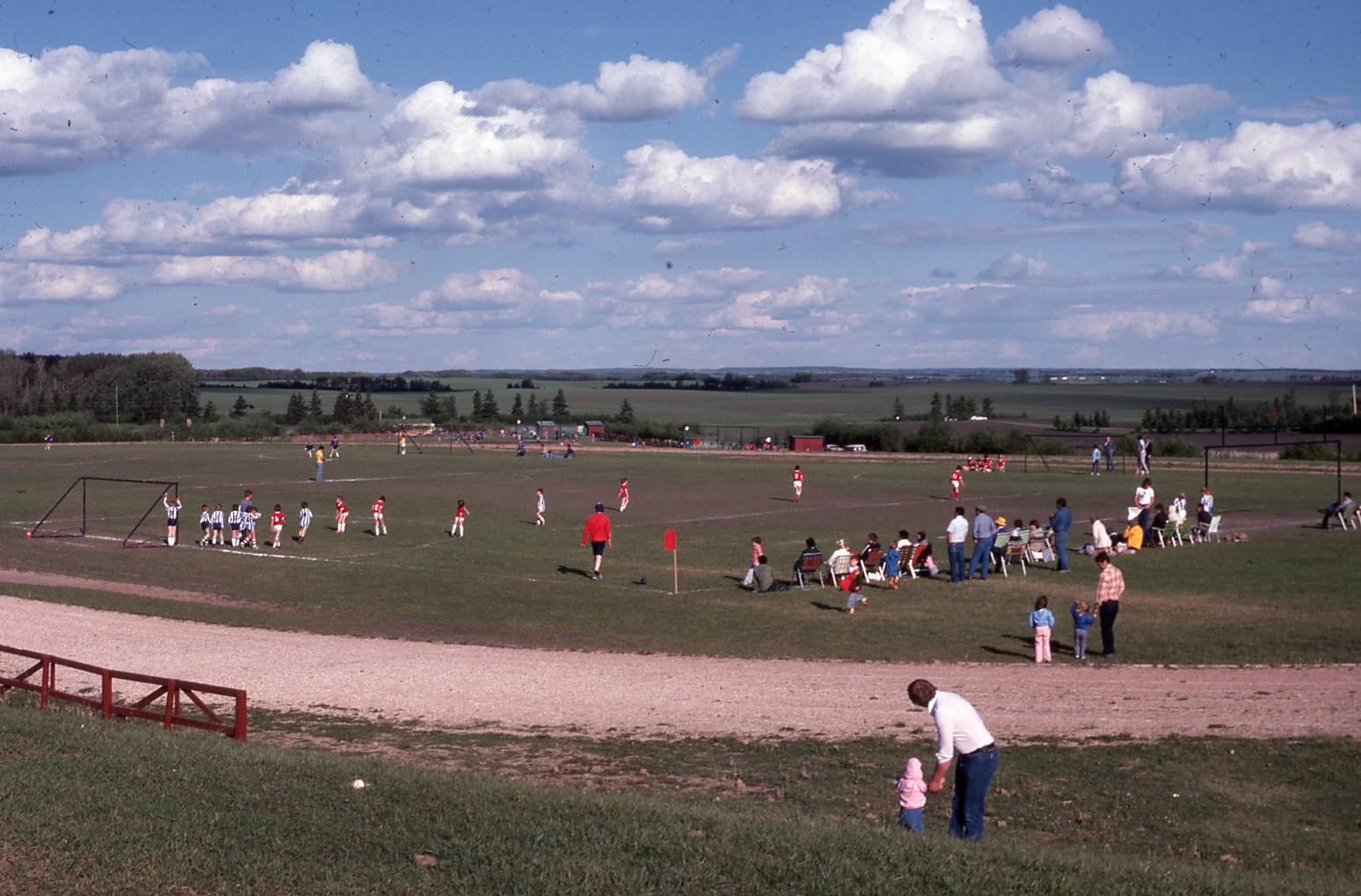
July 1979, courtesy of Strathcona County Museum & Archives
“I destroyed their game,” he says with a coy chuckle, “because – in my mind as a player, you get the ball down here and you want to go to that goal.” He gestures on the table in front of us. “But U12 players, [they] don’t see that – they go wherever the ball goes; and that ball was always hitting me, and I was getting in the way, and I thought ‘how am I going to get out of this?’ So, I said to them, ‘Okay – parents are all on the sideline here – I’m running behind you. Sometimes I’ll run in front of you; but I’m not going in the middle there with the girls! It worked like a charm,” he laughs, “but there was nothing you could do about it because my sense is [during a game], [that] I have to be in that position [on the field] because the ball is coming in – but no, it goes back the other way.”
“I don’t have a favourite [place],” he replies to a follow-up question about his favourite location that he refereed. Instead, he reflects on what it means to be a part of the global refereeing community. “I’ve had many, many, accolades from different countries; players who still talk to me; referees [are] a fabulous family! Every nationality you can think of, and I think of Edmonton as being [an amalgamation] of different countries living and established in the area – you don’t see referees arguing with each other. We’re all one.”
“I was a liaison with CSA (Canada Soccer Association) for many years. When referees came in to referee here and I’d pick them up at the airport; sometimes I’d have them stay over, or from the hotel I’d pick them up and get them to games, when they’d finish, I’d take them back to the airport. [I did all that] because I got treated that way when I travelled. You keep in touch, so it’s a nice big family!”
At the beginning of his referee journey, did Derek ever think he’d end up being a FIFA sanctioned referee? “No, no – I never even thought I’d make it to a ‘Class 1’ level. In those days, the first start was the [Class] 3P (Probation); then you’d referee for a year or two, and you’d go up to a [Class] 3. [After] a couple more years, you’d get up to a [Class] 2. A couple more years [after that], plus the tests and everything, you’d get up to a [Class] 1. After that the next step is National. As I said, I never dreamed I’d ever get into Class 1. When you’re assessed [as a referee] at all the levels, it gets fed into CSA, and you get the opportunity to operate some more – when I got the chance at FIFA, it was one of those [opportunities] I jumped at.”
“I had five [World Cup Qualifying matches]. With FIFA, you were lucky if you got one appointment per year. In my days, you could referee or be on the line, and [it would] change; one game you’re here in the middle, and next game you’re on the line - whereas now, they have strictly Referees and Assistant Referees. In those days, [you’d be] flying in on a Saturday, you’ve got a game on Sunday, then you’d fly home Sunday night.”
With all the travelling to the various CONCACAF nations required for World Cup Qualification, it would be easy to expect some level of comfort to keep the referee’s fresh for their work; but travelling, Derek says, “was back-of-the-plane type of [travel].” Coupled with the pressures of working at the FIFA level, “It’s one of those [situations], where if you make a mistake, you don’t get asked back.” Derek’s career refereeing at the FIFA level spanned those five years from 1987 until 1992, as he explains “when [you] turned fifty, [they] pulled you off the [appointment] list automatically.” However, despite all the successes and the accolades, refereeing is often a thankless job; “what I found out over fifty years - when I retired, I get all the praise; but you never get it when you’re refereeing.”
“It was exciting,” he exclaims, looking back on his career. “Would I do it [now] when I watch what is happening today?” He shakes his head. “No. it’s a different game today.” We ask him to explain, wondering if it is the advances of the modern game today - playing and moving faster, in addition to the continued introduction of technology such as VAR (Video Assistant Referee), that dissuades him from wanting to be a modern-day FIFA referee. But Derek dismisses those aspects of the job. “It’s the other side – it’s the gamesmanship,” he states matter-of-factly. “In my playing days, in the U21 games I played in Vancouver for the Westminster Royals – if I was pulling the stunts that these [players] are [today], the coach would’ve said, ‘Your leg had better be broken, because if it isn’t then I’ll break it [myself] when you get back to the sidelines’. I had played most of my days as a goalkeeper, and when I see this stuff, this rodeo, that takes place today…” he trails off, “but that’s what the fans want, and FIFA’s giving it to them. It’s not the game – as we called it – it’s [now] an entertainment value.”
He provides an example of a modern-day pet-peeve of his when watching the games on the television. “Taking the throw-in; the ball goes out here,” he gestures on the table again. “[the player] can throw it in anywhere from here to the other end – and unless the referee stops you, you’re going to keep going. But the laws don’t change,” he emphasizes, “the law still says, ‘at the place where the ball goes out of bounds’; not where you feel like taking it.” He shrugs, leaning back into his chair, “but that’s the game.”
When his time with FIFA ended in 1992, Derek was still active with Sherwood Park soccer – right up until 2020 and the COVID-19 pandemic. He was responsible for creating a referee development program, to help set others on the path he walked. “I’d go out every night of the week, and when the U10’s were playing, I was walking between all four fields – watching the referees, going on the field when I saw something that needed to be corrected. We had [such large] numbers of referees [in Sherwood Park] – it was unreal. The fans knew who I was, my Sherwood Park tracksuit said ‘Referee Mentor’; if there was a problem [they could] talk to me – don’t go after the kid on the field. It was successful right up until 2020. It was when COVID hit when I decided I wasn’t going to go back to it.”
But old habits are hard to break, and even now in his retirement Derek keeps a trained eye on Sherwood Park soccer from a distance. “I still go out on my bike, and I mean, the kids don’t know who I am – some of the older referees recognize me – but I’ll just watch. Most of the time it’s the referees that I see, not the players, but then the [occasional time I’ll see that] a player is skillful, and able to do the skills – knowing full-well what we’ve taught them here. You’ve got to have the people at the top, who know what they’re doing, to bring [the players] up.”
There’s a lot of pride as Derek observes the club he helped build, and what he’s most proud of over his journey is “the growth of Sherwood Park soccer – nowadays with even adult teams, that in my day we didn’t have. [With] the kids – you see some of the awards coming up [the stairs at the Clubhouse], its there – the development. COVID killed it – not just Sherwood Park – but when you see the numbers of the kids who didn’t come back…just prior to that our numbers were really good. I could go to any field any night of the week and I could see a game. It’s not quite like that anymore, and that’s going to be a long recovery.”
In Derek’s view, the long road is worth walking with the successes of the Canadian National Teams on display, especially with the most recent showing of the 2026 World Cup. “That is a massive change – and I’m going back to my days. The young players. We didn’t have players that young when I refereed Canada. The [Canadian National Team] was getting to the end of their high-level [careers], but you see what is happening today – and you mentioned it – a very fast game; this second generation are all young, their skill levels are way better.”
To reach the bright lights of turning professional and national team representation, player development is at the forefront of everything. “You need a club system – like any of the English Premier League teams, they all have academies. Canada talks about an academy [system] – way [too] late. We should’ve had that back when [they] were developing their core [national team players]. That then triggers every other location [in Canada] to say, ‘Hey, maybe [we] can do that! What do I need to do to get there?’ When you see that, when you see the players coming into the professional leagues and making the first team at eighteen or seventeen, how’d they do that? [You] bring them along. If Sherwood Park can keep doing that…and you’re going to have bumps…but when you see what’s happening with the kids, that’s why we’re here and it’s working well.”
From the house along the small dirt road that became a major street and running a club with a few hundred members, to the heights of refereeing FIFA World Cup Qualifiers, Derek still finds joy in the local game. “I live right by Florian Park; I hear the whistles. I stand out on my deck, and I could tell who the referee was by their whistle.” But which of the Sherwood Park referees has the loudest whistle? “I had it!” laughs Derek. “You’ve got many players that’ll tell you that – because if you were the one who was giving me trouble [during a game], I would wait and bide my time, and then when something happens when I needed to blow my whistle, and you just happened to be in earshot of my whistle…” he sits back in his chair with a wink.
For someone as well-travelled and experienced as him, Derek will tell you that the impact of Sherwood Park Soccer can be seen far and wide. “When I travelled, people ask me, ‘where are you from?’ I say, ‘Sherwood Park.’ [They reply], ‘oh yeah, my kid played [against] them”. Locally, in our own community, the history of our club is still at the forefront of conversation for those original Sherwood Park residents. “I ran into one of the guys who was on my committee. He’s a neighbour now, and it’s interesting to listen to his story.”